Identity and Access Management: A Comprehensive Guide for 2026
 18 December, 2025
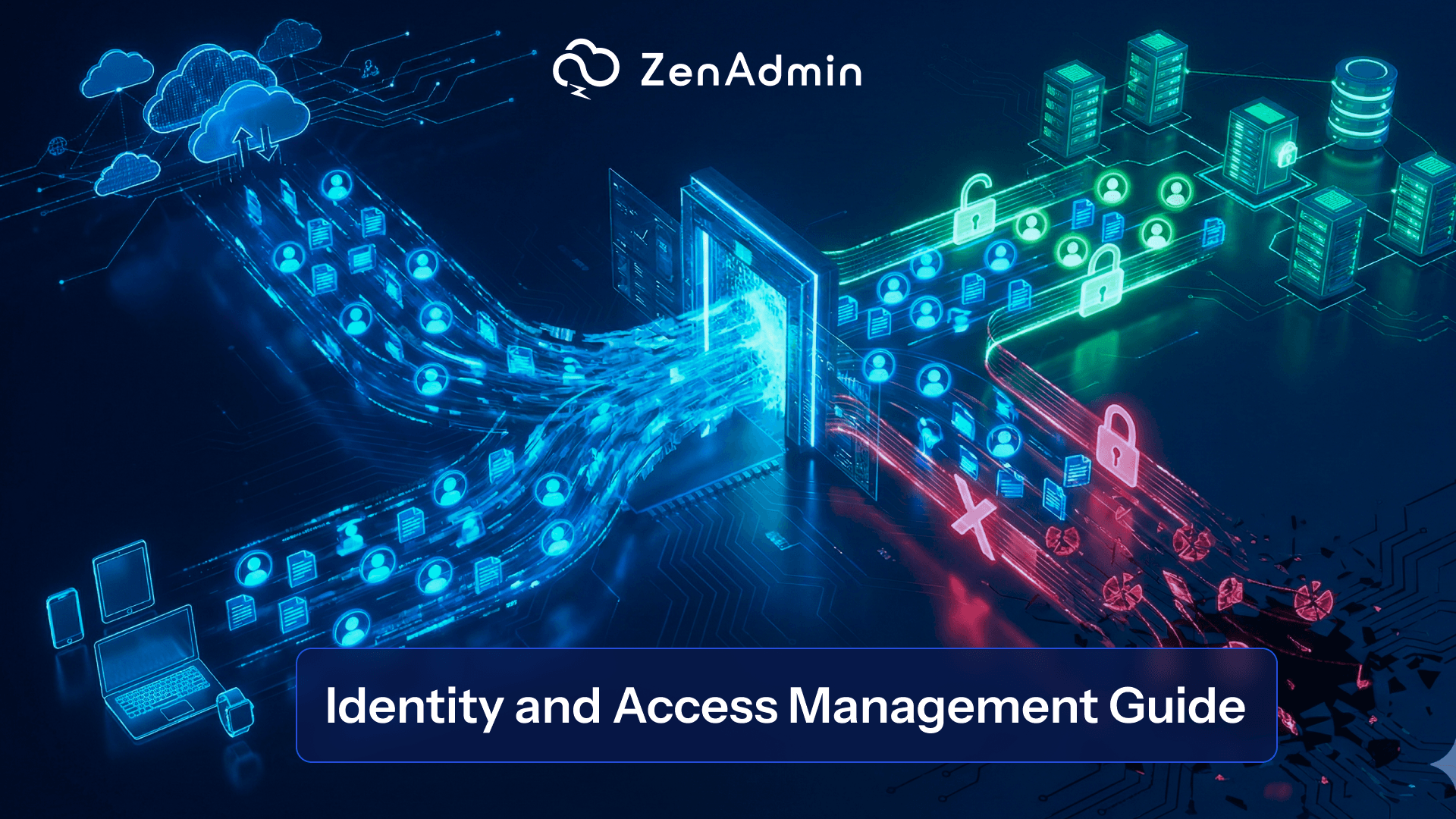
In 2026, Identity and Access Management (IAM) is no longer just an IT concern. It has become a board-level priority.
As organizations accelerate digital transformation, identity has become the new security perimeter. Traditional, network-based defenses are giving way to identity-first security models where every user, device, app, and AI agent must be continuously verified.
Remote and hybrid work have permanently expanded access boundaries. SaaS sprawl has multiplied the number of identities and permissions IT teams must manage. At the same time, AI agents, automation tools, and non-human identities are accessing critical systems at machine speed, reshaping how access is granted and governed.
In this environment, a single misconfigured permission or orphaned account can lead to data breaches, compliance violations, or operational shutdowns.
That’s why IAM failures today translate directly into business risk. In this guide, we’ll explore everything you need to know about Identity and Access Management in 2026, from fundamentals to future-ready strategies.
What Is Identity and Access Management?
Identity and Access Management (IAM) is a framework of policies, technologies, and processes that ensures the right identities have the right level of access to the right resources at the right time. In modern enterprises, IAM goes beyond managing employee logins; it governs access for contractors, partners, devices, applications, and AI-driven systems across cloud and on-prem environments.
At its core, IAM focuses on four goals:
- Authentication (verifying who or what is requesting access)
- Authorization (defining what they’re allowed to access)
- Governance (managing lifecycle events, approvals, and compliance
- Visibility (maintaining clear insight into who has access to what)

Unlike traditional access control, which relied on static roles and network boundaries, IAM is dynamic, identity-first, and built for today’s distributed, cloud-native enterprises.
How IAM Has Evolved (2015 → 2026)
Identity and Access Management has undergone a fundamental shift over the last decade. What started as a back-office IT function has evolved into a strategic security layer that underpins modern digital businesses. As infrastructure, work models, and applications changed, IAM had to adapt, becoming more dynamic, intelligent, and identity-first by 2026.

1. On-prem directories to cloud-native identity
Early IAM systems were built around on-premise directories like Active Directory, designed for employees inside corporate networks. Today, identity lives in the cloud. Cloud-native IAM supports distributed workforces, SaaS applications, and hybrid environments, enabling centralized control without relying on network boundaries.
2. Passwords → MFA → passwordless
Passwords alone proved fragile and risky. Multi-factor authentication (MFA) adds a critical security layer, and by 2026, passwordless authentication, using biometrics, hardware keys, or cryptographic credentials, is becoming the standard for reducing attack surfaces.
3. Human identities to machine, API, and AI agent identities
IAM now manages non-human identities too. APIs, automation scripts, and AI agents require governed, auditable access, making identity management broader and more complex than ever before.
6 Key Components of a Modern IAM Stack
A modern IAM stack is a layered architecture designed to manage identities, enforce access, and reduce risk across dynamic, cloud-first environments.
For CIOs, CISOs, and security leaders, understanding these core components is critical to building a resilient identity strategy.
1. Identity lifecycle management (Joiner–Mover–Leaver)
Identity lifecycle management governs how access is created, modified, and revoked as users join, change roles, or leave the organization.

Automated joiner–mover–leaver (JML) workflows ensure employees and contractors get the right access on day one, changes are reflected immediately when roles shift, and access is fully revoked upon exit. This minimizes orphaned accounts, privilege creep, and compliance gaps—common root causes of breaches.

2. Authentication (SSO, MFA, passwordless)
Authentication verifies who—or what—is requesting access. Single Sign-On (SSO) reduces credential sprawl while improving user experience. Multi-factor authentication (MFA) adds strong protection against phishing and credential theft. By 2026, passwordless authentication using biometrics, FIDO2 keys, or device-based credentials is becoming mainstream, reducing reliance on vulnerable passwords altogether.
3. Authorization & access policies (RBAC, ABAC)
Authorization defines what identities can access after authentication. Role-Based Access Control (RBAC) assigns permissions based on job roles, while Attribute-Based Access Control (ABAC) uses contextual signals like location, device posture, risk level, and time. Modern IAM platforms often combine both to enable fine-grained, adaptive access decisions at scale.
Also Read: Role-Based vs. Attribute-Based Access Control: What’s Right for You?

4. Privileged Access Management (PAM)
PAM secures high-risk, elevated accounts such as admins, root users, and service accounts. It enforces least-privilege access, session monitoring, credential vaulting, and just-in-time elevation. For enterprises, PAM is essential to prevent lateral movement and limit blast radius during security incidents.

5. Identity Governance & Administration (IGA)
IGA focuses on visibility, compliance, and control. It manages access reviews, approval workflows, segregation of duties (SoD), and audit reporting. IGA ensures access aligns with business policies and regulatory requirements, not just technical rules.

6. Directory Services & Identity Providers (IdPs)
Directories and IdPs act as the central source of truth for identities. Modern IdPs integrate cloud directories, legacy systems, and SaaS apps, enabling federated identity, trust relationships, and scalable authentication across the enterprise.

Why Identity and Access Management is a Must in 2026
In 2026, Identity and Access Management is a foundational requirement for operating securely, compliantly, and at scale. As digital environments grow more complex, the absence of a strong IAM strategy introduces risks that extend far beyond IT.
1. Explosion of SaaS applications and shadow IT
Enterprises today rely on hundreds of SaaS tools across teams, often adopted without central IT approval.

Without IAM, access is fragmented across apps, leading to inconsistent permissions and poor visibility. For example, a former employee may retain access to CRM, finance, or analytics tools months after leaving, simply because each app was managed in isolation.
IAM centralizes access, enforces least privilege, and brings shadow IT under governance.
2. Compliance pressure (SOC 2, ISO 27001, DPDP, GDPR, HIPAA)
IT compliance regulations increasingly demand provable control over who can access sensitive data and why. Without IAM, organizations struggle to demonstrate access reviews, audit trails, or timely deprovisioning. A failed audit due to unclear access controls can delay enterprise deals or result in regulatory penalties. IAM provides structured governance, automated reviews, and defensible compliance evidence.

3. Insider threats and credential-based attacks
Most breaches still begin with compromised credentials or excessive internal access. Without IAM controls like MFA, PAM, and continuous monitoring, a single stolen password can expose critical systems and cause IT security issues for remote teams.
For example, an over-privileged engineer account can allow attackers to move laterally across cloud infrastructure. IAM reduces blast radius by enforcing strong authentication and just-in-time access.

4. AI tools and autonomous agents needing controlled access
AI agents, bots, and automation tools now access production systems, APIs, and data stores. Without IAM, these non-human identities often use shared or hard-coded credentials, creating massive security gaps. IAM enables scoped, auditable access for AI-driven workflows, ensuring innovation doesn’t come at the cost of control.
Identity Lifecycle Management: The Foundation of IAM
Identity Lifecycle Management (ILM) is the foundation of any effective Identity and Access Management strategy.
At its core, ILM governs how identities are created, updated, and retired as people join an organization, change roles, or leave – commonly known as joiner, mover, and leaver workflows. When these events are automated, access is provisioned on day one, adjusted instantly as responsibilities change, and revoked immediately at exit.

Modern ILM systems also handle temporary access, role-based changes, and contract workers whose access must expire automatically.
Without automation, access management becomes manual, fragmented, and error-prone. Spreadsheets, email approvals, and ad-hoc scripts simply don’t scale in environments with hundreds of apps and frequent role changes.
Over time, this leads to privilege creep, orphaned accounts, and compliance gaps. By enforcing consistent, policy-driven access across the identity lifecycle, ILM ensures IAM remains accurate, secure, and scalable as organizations grow.
Authentication in 2026: Identity and Access Management Beyond Passwords
Authentication has moved far beyond simple username-and-password models. Modern IAM strategies focus on reducing friction for users while dramatically increasing resistance to phishing, credential theft, and unauthorized access. Authentication is now adaptive, context-aware, and built for cloud-first enterprises.
1. Single Sign-On (SSO)
SSO allows users to authenticate once and securely access multiple applications without repeated logins. It reduces password fatigue, improves productivity, and gives IT centralized control over access. From a security perspective, SSO minimizes credential sprawl and makes it easier to enforce consistent authentication policies across SaaS, cloud, and on-prem systems.
2. Multi-Factor Authentication (MFA)
MFA adds an essential layer of defense by requiring two or more verification factors—something you know, have, or are. In 2026, MFA is standard for workforce and customer identities alike, protecting against phishing and brute-force attacks even when passwords are compromised.
3. Passwordless authentication (biometrics, passkeys)
Passwordless methods replace shared secrets with cryptographic credentials tied to devices or users. Biometrics, hardware security keys, and passkeys reduce attack surfaces while delivering a faster, more secure login experience.
4. Adaptive and risk-based authentication
Risk-based authentication evaluates context—location, device health, behavior, and threat signals—to dynamically adjust security requirements. Low-risk access stays seamless, while high-risk attempts trigger stronger verification or denial.
Popular Authorization Models for Identity and Access Management
Authorization determines what an identity can do after it’s authenticated and in modern IAM, the model you choose directly impacts security, scalability, and agility.
In 2026, enterprises will rely on flexible authorization frameworks that balance control with speed.
1. Role-Based Access Control (RBAC)
RBAC assigns permissions based on predefined roles such as “Finance Manager” or “HR Analyst.” It simplifies access management at scale and works well for stable job functions. However, on its own, RBAC can become rigid, leading to over-permissioned roles as responsibilities evolve.
2. Attribute-Based Access Control (ABAC)
ABAC makes access decisions using attributes like user role, department, device posture, location, data sensitivity, and risk level. This allows for fine-grained, dynamic access that adapts to real-world conditions, especially valuable in cloud and remote-first environments.
3. Least-privilege access in practice
Least privilege means granting only the minimum access required to perform a task. In practice, this involves right-sizing roles, continuous access reviews, and just-in-time elevation for sensitive actions, significantly reducing the attack surface during breaches.
4. Time-bound and context-aware access
Modern IAM supports access that expires automatically or changes based on context. Temporary project access, contractor permissions, or high-risk logins are tightly controlled, improving both security and compliance.
Privileged Access Management (PAM) Explained
Privileged Access Management (PAM) focuses on securing accounts that have elevated permissions, such as system administrators, root users, database admins, cloud superusers, and service accounts.
These identities have broad access across critical systems, making them prime targets for attackers. When privileged accounts are unmanaged or shared, a single compromised credential can lead to full infrastructure takeover, data exfiltration, or ransomware deployment.

Modern PAM reduces this risk through just-in-time (JIT) access, where privileges are granted only when needed and revoked automatically after use. Session monitoring and recording add another layer of protection, enabling real-time oversight and forensic audits. PAM also enforces credential vaulting, rotation, and least-privilege policies to limit blast radius.
By controlling and auditing high-risk access paths, PAM plays a critical role in breach prevention. Platforms like ZenAdmin strengthen PAM by combining identity visibility with device and access controls, ensuring privileged access is secure, temporary, and fully accountable across your IT environment.
Governance & Compliance for Identity and Access Management
Governance and compliance are where Identity and Access Management delivers measurable business value. Beyond securing access, IAM provides the structure, visibility, and evidence organizations need to meet regulatory expectations in 2026 and beyond.
1. Access reviews and certifications
Access reviews ensure users have only the permissions they need and nothing more. IAM platforms automate periodic certifications where managers and application owners review and approve access. This helps eliminate privilege creep, validate business justification, and demonstrate control over sensitive systems, especially for finance, HR, and production environments.
2. Audit trails and reporting
Strong IAM systems maintain detailed, immutable audit logs covering authentication events, access grants, privilege escalations, and deprovisioning actions. These audit trails enable faster investigations, support internal security reviews, and simplify external audits. Instead of manual data collection, compliance teams can generate on-demand reports aligned to specific regulatory requirements.
3. Segregation of duties (SoD)
SoD prevents conflicts of interest by ensuring no single individual can perform incompatible actions, such as creating vendors and approving payments. IAM enforces SoD policies at the access level, detecting violations during provisioning and flagging risky combinations before they lead to fraud or compliance breaches.
Whether it’s SOC 2, ISO 27001, GDPR, DPDP, or HIPAA, regulators expect clear identity controls. IAM enables continuous compliance by aligning access with policy, proving enforcement, and reducing audit friction, turning compliance from a reactive exercise into an always-on capability.
Identity and Access Management for Remote, Hybrid, and Global Teams
Remote, hybrid, and globally distributed teams have fundamentally changed how identities and access must be managed. Employees now log in from multiple locations, devices, and networks, making centralized, identity-first control essential. Modern IAM ensures consistent access policies across geographies while adapting to local risk signals like device posture, location, and network trust.
Contractors, freelancers, and vendors add another layer of complexity. Their access must be limited, time-bound, and automatically revoked, without slowing down operations. Conditional access policies that factor in device trust, identity risk, and behavioral signals help prevent unauthorized access, even outside corporate networks.
This is where a unified platform like ZenAdmin becomes critical. ZenAdmin manages the entire identity lifecycle, from IT procurement and device onboarding to role-based access and secure deprovisioning, all through a centralized dashboard.
With global operational support, ZenAdmin ensures that whether your teams are remote, hybrid, or fully distributed, you always know who has access to what, everywhere.

Identity and Access Management for SaaS-First Organizations
SaaS-first organizations operate in environments where access changes constantly. With teams relying on hundreds of cloud applications, Identity and Access Management becomes the control plane that keeps speed, security, and cost in balance.
1. Centralized access for hundreds of apps
IAM provides a single layer of control across the entire SaaS stack. Instead of managing access inside each application, IT teams define policies once and enforce them everywhere through SSO and centralized provisioning. This ensures consistent authentication, faster onboarding, and immediate access revocation when roles change or employees leave.
2. Reducing SaaS sprawl and license waste
Without IAM, unused accounts and duplicate licenses quietly drain budgets. Centralized visibility shows which apps are being used, by whom, and at what level. Automated deprovisioning reclaims licenses instantly, while access governance helps eliminate shadow IT before it becomes a security or financial risk.
3. HR-driven IAM workflows
Modern IAM is triggered by HR events. When an employee joins, moves teams, or exits, HR systems automatically initiate access changes. This aligns access with job roles in real time, removes manual handoffs, and ensures no one retains access beyond their employment.
4. Integrations with HRIS, ITSM, and security tools
IAM delivers maximum value when integrated into the broader IT ecosystem. Platforms like ZenAdmin connect seamlessly with HRIS, ITSM, and security tools to automate the full identity lifecycle. ZenAdmin fulfills all these criteria by unifying SaaS access, license management, and identity workflows, giving SaaS-first organizations centralized control, lower costs, and stronger security from one dashboard.
Common Identity and Access Management Challenges (and Why They Persist)
Despite widespread adoption of identity and access management tools, many organizations still struggle with the same identity challenges year after year. The reason isn’t a lack of technology—it’s fragmented implementation, siloed ownership, and identity complexity growing faster than controls.
1. Tool sprawl and fragmented identity data
Enterprises often deploy multiple IAM-related tools across SSO, PAM, IGA, directories, and device management. When these systems don’t integrate cleanly, identity data becomes fragmented. Different sources of truth create inconsistencies in roles, permissions, and user status, increasing security risk. In fact, with an IAM software, there’s so much room to optimize SaaS costs. And mind you, businesses are paying quite a lot for it.

2. Manual processes and delayed deprovisioning
Many access changes still rely on tickets, emails, and spreadsheets. This slows onboarding, creates bottlenecks during role changes, and delays deprovisioning when employees leave. Even short delays can expose critical systems, especially in SaaS-heavy environments where access is instant but revocation is not.
3. Poor visibility into “who has access to what”
Without centralized dashboards and IT standardization, security teams lack real-time insight into user access across applications, devices, and infrastructure. This makes audits painful, incident response slower, and compliance harder to prove. Visibility gaps are often only discovered during breaches or failed audits.
4. User friction vs security trade-offs
Security controls that disrupt workflows often get bypassed. Poor identity and access management balances lead to either poor adoption or weakened security. Modern IAM must deliver strong protection while remaining seamless; otherwise, risk simply moves elsewhere.
How to Evaluate an Identity and Access Management Solution in 2026
Choosing the right Identity and Access Management solution in 2026 requires more than feature comparison; it demands a practical assessment of how well a platform supports scale, speed, and security in real-world environments.
1. Must-have features
Start with the basics done right. Look for SSO, MFA, passwordless support, automated provisioning and deprovisioning, role-based and attribute-based access, audit logs, access reviews, and privileged access controls. If these aren’t native or tightly integrated, complexity will creep in fast.
2. Scalability and automation capabilities
IAM must scale with headcount, apps, and non-human identities without increasing manual work. Prioritize solutions that support HR-driven workflows, just-in-time access, policy-based automation, and lifecycle management across employees, contractors, and service accounts.
3. Integration ecosystem
A strong IAM platform integrates seamlessly with your SaaS stack, HRIS, ITSM, cloud infrastructure, and security tools. Limited or brittle integrations create identity gaps. Evaluate pre-built connectors, API maturity, and how quickly new apps can be onboarded.
4. User experience for employees and admins
Poor UX leads to workarounds. Employees should experience fast, low-friction authentication, while admins need centralized dashboards, clear visibility, and simple policy management. Ease of use directly impacts security adoption.
5. Security, compliance, and vendor trust
Assess security posture, compliance certifications, data handling practices, uptime, and roadmap. A trustworthy vendor should support audits, global operations, and evolving regulatory requirements without slowing your business.
Best Practices for Implementing Identity and Access Management
Implementing Identity and Access Management successfully requires more than deploying tools. It demands thoughtful planning, cross-functional alignment, and continuous optimization. Here are 10 best practices to ensure your IAM program delivers real security and business value:
- Adopt a phased rollout strategy: Start with high-impact areas like SSO, MFA, and automated joiner–leaver workflows. Gradually expand to advanced controls such as PAM and IGA to avoid disruption and ensure smoother adoption.
- Align IAM with HR and IT workflows: Integrate IAM with HR systems and IT service management so access changes are triggered automatically by role updates, transfers, and exits—eliminating manual handoffs.
- Design access around roles and attributes: Build clean, well-defined roles and supplement them with contextual attributes to reduce over-permissioning while maintaining flexibility.
- Automate provisioning and deprovisioning everywhere: Manual access management doesn’t scale. Automate onboarding, role changes, and offboarding across all apps, devices, and systems.
- Implement least-privilege and just-in-time access: Grant minimal default access and elevate permissions temporarily only when required, especially for privileged roles.
- Prioritize change management and employee adoption: Communicate clearly, train users, and design low-friction authentication experiences to prevent workarounds.
- Centralize visibility and reporting: Maintain a single dashboard to answer “who has access to what” instantly, critical for audits and incident response.
- Secure non-human identities early: Apply IAM controls to APIs, service accounts, and AI agents to avoid blind spots.
- Continuously review and certify access: Schedule regular access reviews to prevent privilege creep and maintain compliance.
- Measure IAM success with KPIs and metrics: Track time-to-onboard, deprovisioning speed, access review completion, MFA adoption, and incident reduction to guide improvements.
Final Thoughts: Making Identity and Access Management a Strategic Control Plane
Identity and Access Management has evolved into a strategic control plane, one that sits at the intersection of security, compliance, and productivity.
In a world defined by SaaS sprawl, remote work, and AI-driven operations, identity is the only constant. Organizations that treat IAM as foundational infrastructure gain tighter risk control, faster operations, and stronger regulatory readiness, without slowing their teams down.
Those that invest early don’t just prevent breaches; they build scalable systems that adapt as their workforce, tools, and technologies evolve. IAM becomes an enabler of growth, not a blocker.
To achieve this, you need an identity and access management platform like ZenAdmin. By unifying identity, access, devices, and lifecycle management under one centralized dashboard, ZenAdmin gives complete visibility into who has access to what at every stage of employment.
Book a demo today to see how ZenAdmin can help you turn identity into a competitive advantage.


